AI-Powered Investing

From Fragmented Advisory to AI-Driven Investment Decisions
Project Date: 2025 - 2026 , Zürich | Clients: UBS | My Role: Service Design
Problem framing
Advisors rely on 10+ internal platforms to access fragmented data and insights.
Core friction
-
Fragmented tools → constant context switching
-
Information overload → hard to synthesize quickly
-
Manual workflows → proposals rebuilt from scratch
Quantified impact
15–30 minutes lost per client interaction
Key Insights
-
Advisors don’t actively search — they scan and react
-
Value lies in decision acceleration, not information access
-
Fragmentation — not individual tools is the core bottleneck
Understanding the advisor workflow

Mapping the advisory workflow revealed that fragmentation impacts every stage — from discovery to client communication.
Design Principles
1. Design for scanning, not searching
Surface opportunities proactively instead of relying on manual queries
2. Optimize for decision-making, not information access
Prioritize actionable insights over raw information
3. Solve fragmentation through centralization
Unify tools into a single decision layer
Solution
Based on these principles, I contributed to shaping the Investment Hub as a centralized decision layer combining:
1. Signal → Opportunity surfacing
AI scans client portfolios and market signals to surface relevant investment opportunities.
2. Context → Intelligent matching
Links research insights to specific client portfolios and recommends suitable products.
3. Output → Client-ready generation
Generates clear, personalized investment messages ready for client communication.
End-to-end advisory workflow powered by AI
The redesigned workflow integrates AI capabilities into each stage — enabling end-to-end decision-making without context switching.

Each stage is powered by integrated modules such as Next Best Client, Investment Hub, and Storyteller, enabling end-to-end decision-making without context switching.
Product Architecture
To support this workflow, I defined a modular architecture that connects AI capabilities with advisory workflows.

The platform architecture illustrates how global AI capabilities, structured workspaces, and embedded insight modules come together to support the end-to-end advisory workflow.
It is structured around three key layers:
-
Global AI capabilities (e.g. search, summarization)
-
Structured workspaces aligned with advisor tasks
-
Embedded insight modules supporting decision-making
Together, these form a unified decision layer that enables end-to-end advisory without context switching.
Explore supporting modules
1. Next Best Client
(Supports: Opportunity identification)
Identifies high-priority clients based on portfolio signals, enabling proactive opportunity discovery.
2. Storyteller (Portfolio Summary)
(Supports: Insight compression, Client-ready output)
Transforms fragmented data into concise, client-ready narratives to support communication.
3. Investment Hub
(Supports: Intelligent matching, Decision-making)
Serves as the central workspace where insights are aggregated and decisions are made.
4. OneSearch
(Supports: Information access across all stages)
Provides a unified search layer to access, compare, and evaluate information across systems. (Detailed case study in the following section.)
Example flows
Flow 1 — From opportunity discovery to client-ready proposal

Identify opportunity → Evaluate options → Generate proposal → Present to client
Flow 2 — From passive monitoring to proactive client prioritization
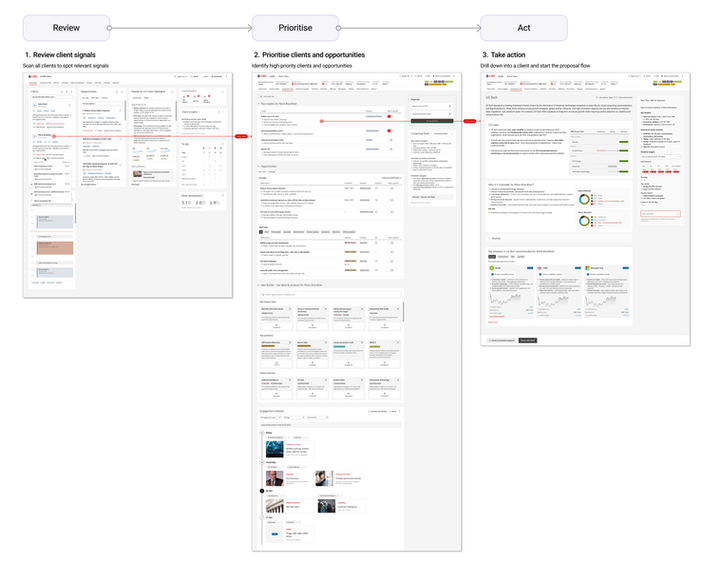
Scan signals → Identify high-priority clients → Take action proactively
Impact
The Investment Hub significantly reduces time spent searching and synthesizing insights:
-
5–10 minutes saved per client when gathering research and bank views
-
Up to 30 minutes saved for complex proposals involving product comparison
This allows advisors to focus more on client interaction and value delivery, rather than operational tasks.